
Iran Conflict Escalates: Bitcoin Tests $70K
Bitcoin absorbs macro shock while Washington shifts on crypto, AI agents evolve, and structured capital builds on-chain.
Global markets are navigating severe macro tension following the recent Iran strikes, yet Bitcoin is opening March with notable relative strength. After dipping toward $65,000, BTC quickly reclaimed momentum, testing the psychological $70,000 level as equity markets opened and now holding near $69,000.
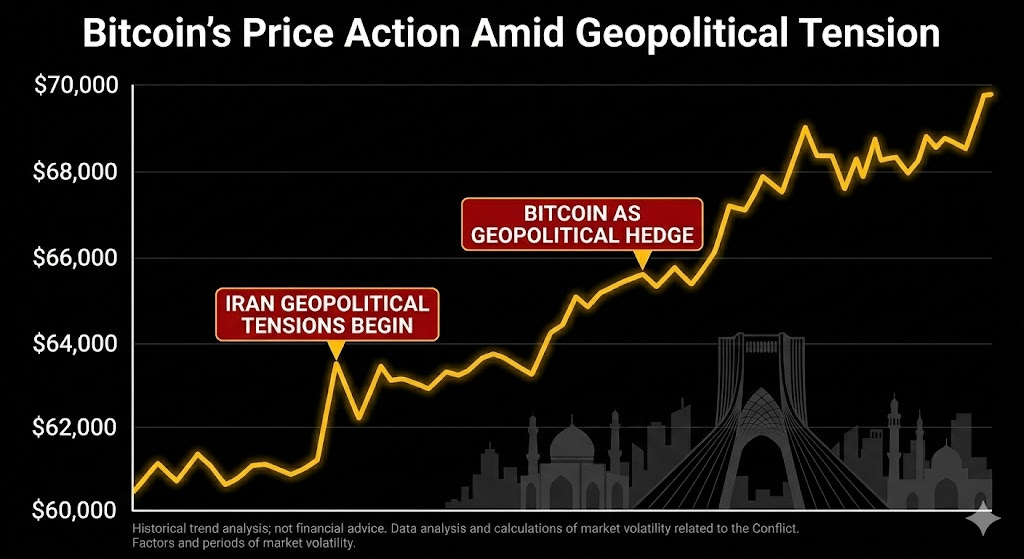
So, why is Bitcoin pushing up today such a massive signal?
During geopolitical escalations, risk assets typically weaken as capital moves to safety. Instead, Bitcoin absorbed the weekend shock and pushed higher into Monday’s open, a signal of structural demand rather than panic liquidation.
Whether this conflict escalates or resolves, Bitcoin’s resilience stands out. Weekend macro shockwaves failed to push BTC price lower while traditional markets were closed. Now, with equities reacting, Bitcoin is already testing 70k resistance.
Meanwhile, the broader crypto industry adoption has not skipped a beat. Institutional adoption and real world integration continue without hesitation, as major enterprises clearly recognize blockchain as the foundational infrastructure of the future global financial system.
Below is a detailed technical breakdown of exactly where Bitcoin and Ethereum stand today, along with insights from fundamental platforms and companies I have spoken with recently.
The Growing Push to Make Crypto a Bipartisan Priority
Crypto has struggled to gain bipartisan support, but that may be changing.
In our latest political Web3 interview with Open Frontier, I speak with a Democrat led lobbying group working to make crypto a bipartisan issue and engage leaders like Senator Elizabeth Warren. Their goal is to advance Bitcoin, digital assets, and blockchain technology with support from both parties.
Watch the full interview to learn more.
The Rise of Autonomous AI Agents That Execute for You
On the AI front, as Claude, CoWork, and OpenClaude improve, we are also exploring open source and decentralized alternatives. The focus is on AI agents tailored to your financial goals that can take action for you, not just generate text.
We recently spoke with Action Model, which is building decentralized AI agents that execute tasks on your behalf. Instead of chatting and doing the work yourself, you tell it what to do and it handles the execution.
Listen to our interview to learn more.
Building an On Chain Hedge Fund on Hyperliquid
On the Hyperliquid front, we are tracking the rapid growth of its ecosystem and the structured products emerging on HyperCore and HyperEVM.
We recently spoke with Rip.xyz, which is building institutional grade vault strategies that provide tokenized exposure to high conviction assets like Hypurr NFTs. Designed as an on chain hedge fund structure, Rip actively deploys capital across 24/7 markets to offer streamlined access to high beta opportunities within Hyperliquid.
Listen to our interview with Rip.xyz to learn more about structured exposure in the evolving DeFi landscape.
🔗 Sponsored by XYO Network
The original DePIN protocol with more than 10 million nodes is now powered by its newly launched XYO Layer One blockchain. Built for high volume data applications, AI infrastructure, and real world asset tokenization, XYO operates with dual token economics using $XYO and $XL1. This is where next generation builders go when legacy chains cannot scale.
Market Analysis:
BTC 4H Medium-Term Technical Outlook
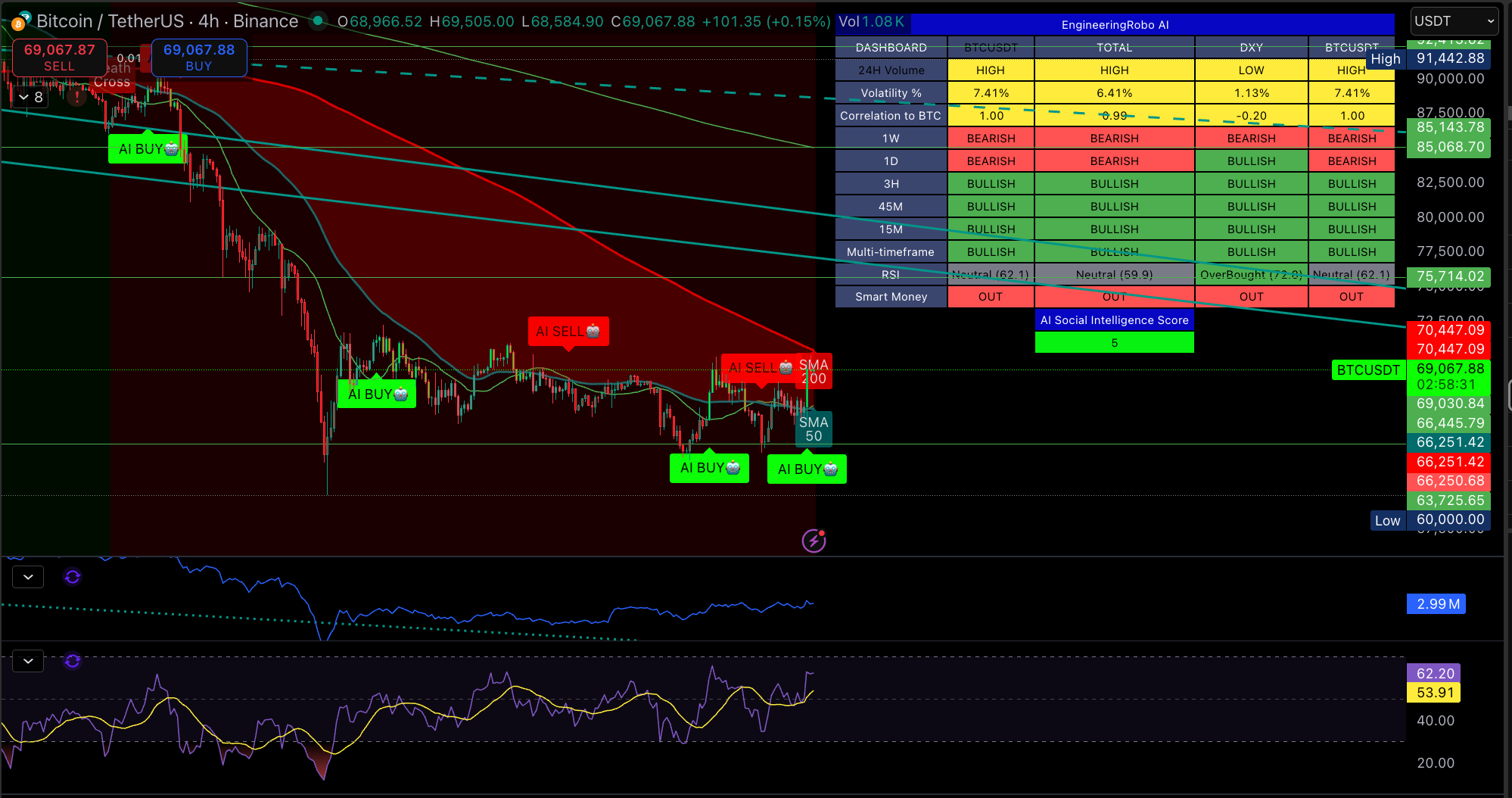
Bitcoin is trading near $69,000 on the 4-hour Binance chart, staging a sharp recovery from the recent $66K swing low. While lower timeframes have turned constructive, higher timeframes remain structurally bearish. A decisive break above the current consolidation range, which formed after the February 5 dip, is required to shift momentum more convincingly.
A key technical factor is the downward-sloping 200-day moving average (200MA). Bitcoin must break above this level and establish support on it to transition into bullish territory.
Once price breaks out of the descending channel, the next step would be establishing a series of higher highs and higher lows, ideally building support above the $70K level.
Although the 4-hour timeframe and lower are showing bullish momentum, the 1-day chart will not turn bullish until price breaks the channel and reclaims the key moving averages.
Key Levels to Watch
Immediate Resistance
$69,500 – $70,400: Confluence zone near the 200 SMA and prior supply
$75,700: Higher-timeframe resistance pivot
$85,000: Major structural resistance from the breakdown area
Support
$66,250: Recent breakout base
$63,725: Key swing low
$60,000: Psychological and structural support
A rejection at $70K that produces another lower high would reinforce continuation toward the $66K–$63K region. Conversely, a clean break and sustained hold above $70.4K would open the path toward $75K.
More information on Bitcoin’s current state can be found in our infographic below.
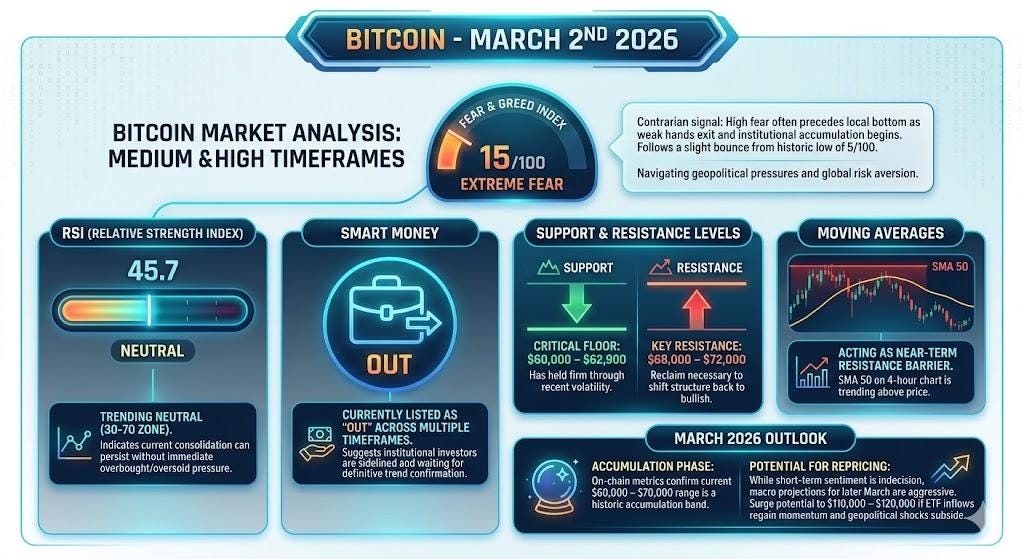
The $60,000 to $63,000 zone remains a high-interest accumulation area if retested. The Smart Money indicator remains neutral to defensive, which may reflect seller exhaustion rather than renewed distribution. A breakout in OBV would confirm renewed capital inflows.
Ethereum 4H Technical Outlook: Counter-Trend Bounce Into 200 MA Resistance
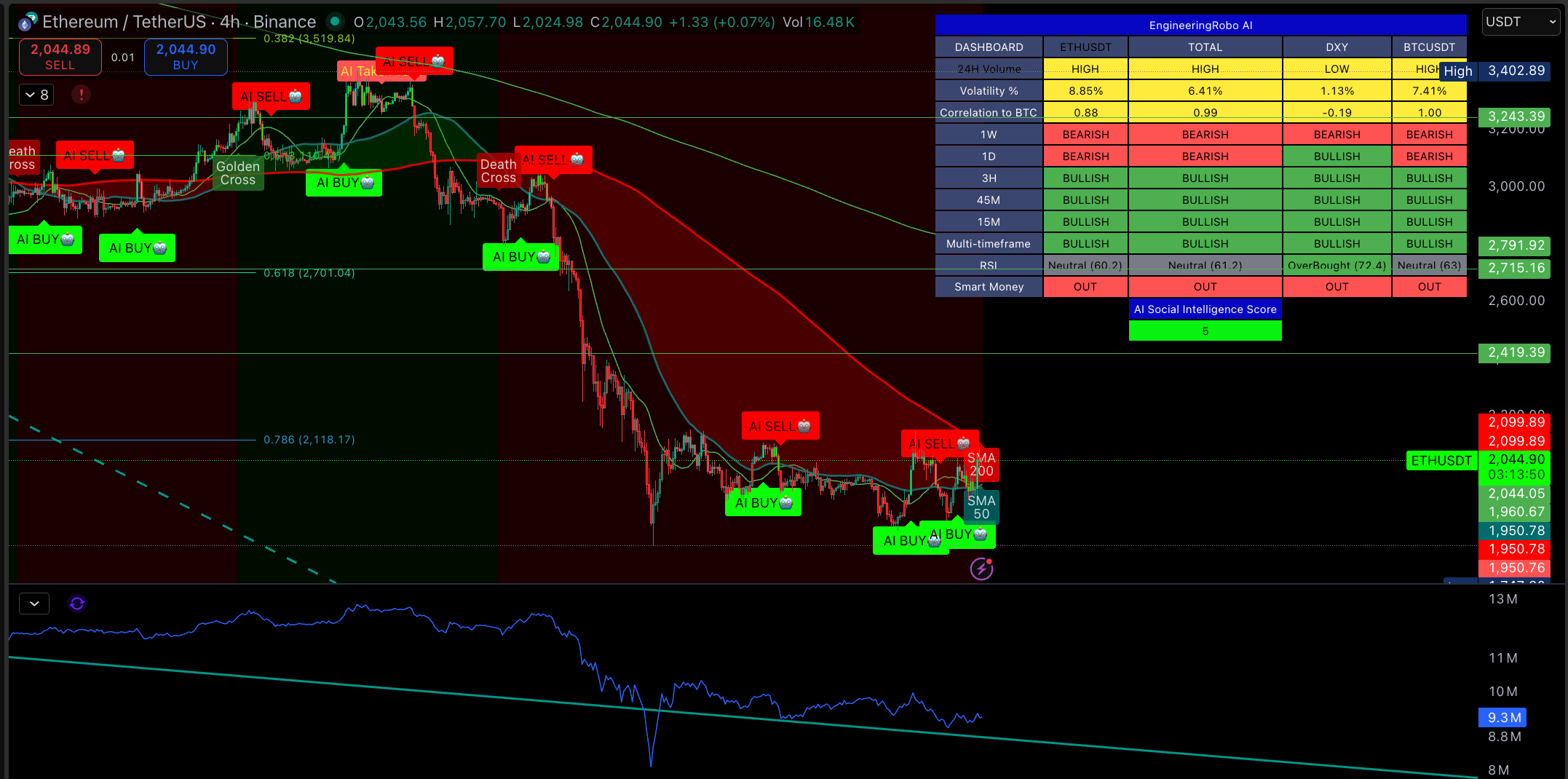
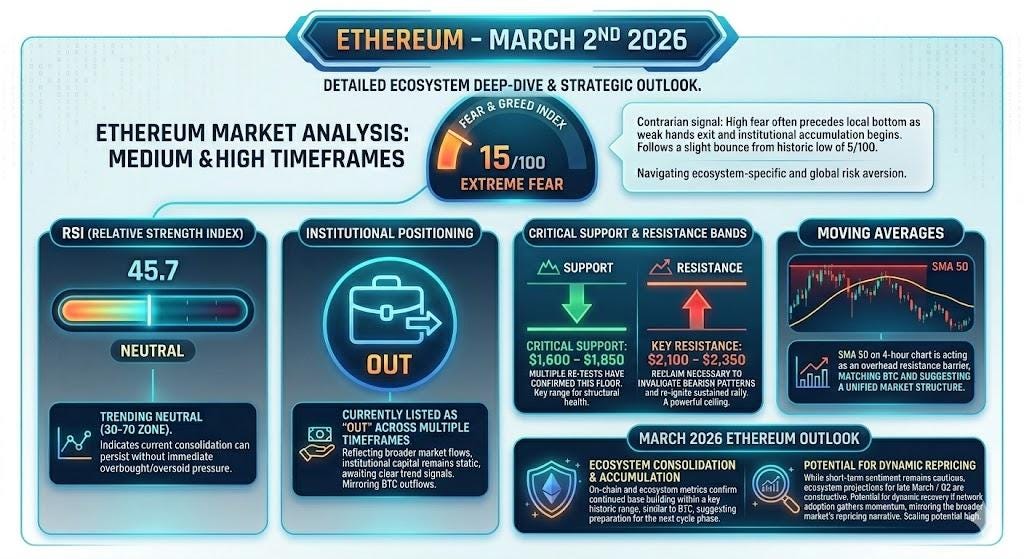
Ethereum is trading near $2,045 on the 4 hour Binance chart, attempting to stabilize after a sharp selloff from the $3,400 region ahead of the late January crash. Price bounced from the $1,950 to $1,960 area and is now pressing into key moving average resistance, specifically the downward sloping 200 day moving average.
While short term momentum has improved, the broader 4 hour structure remains bearish beneath the 200 day MA. A decisive break above this level, followed by sustained support, is required to shift Ethereum back into a bullish structure. The reaction in the $2,090 to $2,100 region will determine whether this is simply a relief bounce or the start of a broader structural recovery.
As with Bitcoin, risk remains elevated in the current volatility environment, making confirmation and disciplined positioning essential. More details on Ethereum’s support and resistance levels, smart money positioning, and relative strength are available in the infographic below.
Other Crypto/AI News this week:
Institutional Adoption & Banking
National Crypto Bank Approval (Feb 23): Crypto.com received conditional approval to operate as a national US crypto bank, marking a significant step for centralized exchanges moving into traditional banking.
Morgan Stanley Custody (Feb 27): The $2 trillion asset manager officially filed for a US bank charter to provide custody for crypto assets.
MetaMask x Mastercard (Feb 26): MetaMask and Mastercard officially launched a crypto debit card in the US, simplifying the bridge between DeFi and retail spending.
UAE “Digital Gold” Label (Feb 24): Emirates NBD, the UAE’s second-largest bank, officially categorized Bitcoin as “digital gold” in a shift toward institutional acceptance.
Corporate & Venture Strategy
MicroStrategy Buying Spree (Feb 23/March 1): Michael Saylor’s Strategy purchased an additional 592 Bitcoin ($40M). As of March 1, Saylor continues to hint at further aggressive acquisitions.
Binance Commodity Growth (Feb 26): Binance surpassed $70 billion in commodity trading volume following the successful launch of its gold and silver futures platform.
Stripe & PayPal Rumors (Feb 24): Reports surfaced that Stripe is considering a massive acquisition of PayPal, which would consolidate two of the largest players in global digital payments.
Protocol & Tech Updates
Ethereum ‘Strawmap’ (Feb 25): Vitalik Buterin and the Ethereum team unveiled a new roadmap focusing on private transactions, quantum-proof security, and massive L2 scaling.
AI Infrastructure Deal (Feb 25): A coalition of top AI firms, including xAI, Meta, Google, OpenAI, and Microsoft, reached a deal to build their own dedicated electricity supply for data centers.
SpaceX IPO Plans (Feb 27): Elon Musk’s SpaceX is reportedly planning a 2026 IPO at a $1.75 trillion valuation.
Legal & Regulatory
Terra vs. Jane Street (Feb 23): Terra filed a lawsuit against Jane Street, alleging that insider trading played a direct role in the $UST and $LUNA collapse.
Stablecoin Rewards Rule (Feb 26): US federal banking regulators proposed a new rule designed to restrict how banks handle and offer stablecoin rewards.
AI & Geopolitics
Anthropic Designated “Risk” (Feb 27): The US government officially designated AI company Anthropic as a “supply chain risk,” while President Trump ordered federal agencies to stop using their Claude AI model.
Pentagon & OpenAI (Feb 27): OpenAI reached an official deal with the Pentagon to deploy its AI models for US military use.
Thanks for reading Crypto Coin Show Insider!
Thanks for reading!
-Ashton Addison, CEO of Crypto Coin Show